Breaking Habits

Posted by on February 24, 2010

I just sat down with my wife and took her through Google docs. She wasn’t too happy about it. I tried to find some old copy of Office I could plonk on her new computer, but when that search was fruitless, Google docs triumphed over forking out more cash for (yet another) copy of Office.

On the first introduction to Google docs, there was a lot of kicking and screaming - what do you mean it can’t do that? How do you do this? That’s just stupid, why doesn’t it work like Excel? I knew this pain was coming, but I persevered because I knew that everything she wanted to accomplish could be done in Google, for free, and live permanently online (which was a bonus as the day before she accidentally deleted her entire My Documents folder - yes, she works in tech).

Sure enough, after a few weeks of working through and learning the new software, she is very content with her move online.

It interesting seeing this process first-hand, especially if you develop UIs (as I do now and then). A function that accomplishes an existing task in a different (but more efficient) way is normally loathed by the user. Especially if the efficiencies are ‘under the user radar’ - by that I mean small enough to not be individually noticed, yet in aggregate, meaningful.

When this happens you are trying to break a habit. Which is hard. Habits drive a considerable amount of our behavior because they are short-cuts we don’t need to think about. When you are forced to change a habit, you weigh the effort in changing against the perceived usefulness of the new approach. If the effort seems too much, you see a lot of kicking and screaming.

This is why you have to be careful with user feedback. Users want everything familiar, not necessarily better - because they don’t want to have to change their habits.

Sometimes you need to push through this barrier to a better place. Sometimes. It’s a fine line between functionality that improves the experience but breaks a habit, and functionality that’s simply different and annoying to users.

Either way, I suggest you try not to test too much on your wife.

The Long Tail of the Long Tail

Posted by on December 26, 2009

I was just perusing some blog feeds in the downtime on Christmas Day and came across a link on Brand New to an Economist article about the hit aspect of the Long Tail debate.

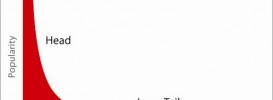
More and more articles about the Long Tail tend to devolve the theory into a general comment on the state of industries affected by Internet economics.  Whereas Chris Anderson’s original argument is very ‘niche’ and specific - describing a set of circumstances that result in a specific outcome rather than a large, generalized theory of everything Internet related.

As I see more commentary on the Long Tail, it’s like a Long Tail of the Long Tail - arguments that tend to twist and turn the original idea to suit a set of observations or opinions.  Sometimes interesting, sometimes a stretch.

But alas, that is the destiny of many a theory.  Maybe the best ones tend to devolve to this kind of reference state - their specifics long ago forgotten, but their general idea intact well enough to guide curious minds who happen along their path.

The Tipping Point is another one that has achieved this ethereal status - although I can’t but help wonder if that was the point all along.

I can’t also help wonder if, by reducing the original Long Tail argument to a reference point, a lot of the original intent and usefulness is lost.

The Economist article has a section on the success of hit TV shows despite falling ratings from wandering eyeballs.  The argument being that even with reduced audiences numbers, we are still gravitating towards these ‘hits’ - as if there is comfort still in broad and common social discourse based on shared entertainment experiences.  Yet network TV in the US is in no way, shape, idea, structure, form, construction, similar in anyway, at all, to the basic tenants that underly the Long Tail theory.

The Long Tail adds nothing to the argument other than a reference for the general idea - that TV is generally full of more choice, that some of this is useful, but we still tend to choose similar things.

Chris Anderson has largely given up the fight to defend different interpretations of his theory.  I think this is a good thing.

It’s time to let the Long Tail go silently into the night.  With the realization that in death, it’s infinitely more powerful than in life.

The Long Tail, I predict, will truly become the Obi-Wan Kenobi of Internet theories.

Yes, this blog is still alive!

Posted by on November 25, 2009

When life and work conspire to consume all your available time, something has to give and blogging just happened to be in the firing line.

We’re actually rolling out the first large (400+ user) site for our company.  More detail on how that went down the road.  It’s been an interesting journey.

I’ll try to post a few more times over the Holidays as things tend to quiet down a bit.

Thanks for everyone who checks this feed!

Happy Holidays to my US readers.

Digg Reader Survey And Our Flawed Understanding of Online Behavior

Posted by on September 24, 2009

I recently took a readership survey on the Digg site and realized there were some fundamental flaws in the way we are trying to understand online behavior.  And this is by no means solely a problem at Digg, it speaks to a deep seated bias we have when trying to probe media behavior.

Some examples from the Digg survey:

Question: How often would you say you go online?  Many times a day, daily, weekly, etc.

Between my home computer that I never turn off, my work computer I turn off once a week, my cellphone and my Ipod Touch, I don’t think I am never NOT online.

At some point the distinction between online and offline blurred to such a degree that there is now no meaningful demarcation.   I can certainly ‘disconnect’ myself, and do.  But even then, I am conscious that my online presence still ‘exsits’ and perpetuates itself without my direct involvement.

In this sense, the more important measure is how integrated my ‘online’ and ‘offline’ lives are, not how often I switch between the two.

Question:  Which of the following do you visit at least once a month?  <list of websites>

What exactly is a ‘visit’?  I have a iGoogle home page that streams 10 different RSS feeds, am I ‘visiting’ each of those sites every time I read the feed?  Do I have to click through to them for it to count?  What about my RSS reader where I look at the BBC news, is each article a visit?  What about the CNN Breaking News emails I get?  Are those ‘visits’?  If I never turn off Twhirl, how many visits is that a day to Twitter feeds?

Again, ‘visit’ is a remnant of an earlier online experience and one with roots in TV and radio - where the only way to get to the information was to physically change the channel.

We need to think about ‘consumption’ not ‘visitation’ when thinking about online media.

Question: Rank these reasons for spending time online - entertain, research, manage my life, etc.

Why do I go online?  What’s most important?  This question loses all meaning when you think of your online life as an extension of your offline one.  ’Online’ is not a destination with a cause and reason to visit, it’s a fluid extension of real needs/wants/desires.

‘Needs’ is the real issue here - what needs does your online life fulfill?

The survey continued in the same vein with subsequent questions.  Websites were treated as destinations and ‘visits’ and the online experience had reason and purpose.

I think it’s time to rethink a lot of how we measure ‘online behavior’.  Rather than assuming individuals online are ‘destination’ seekers, we need to think about how individuals aggregate and move between the nodes of the network they create.  It doesn’t mean destination seekers don’t exist, it just doesn’t adequately explain the complexity of their online world.

Bottom line, why measure online behavior like we used to measure offline behavior?  A mouse isn’t simply a different way to navigate, it’s a paradigm shift in your relationship to information.

I thought Digg, of all companies, would have understood that.

Quick update

Posted by on September 21, 2009

I’ve been neglecting my blog recently out of simply having no time to sit down and write!  Lots of work, lots of traveling.

I wanted to write something about the current health care debate raging in the US, but it’s difficult to synthesize thoughts into a coherent posts as there are so many aspects to it all.

So my simple observation, and the one I find most compelling, is how in a county that so prides itself on freedom of speech and freedom of expression, public discourse can so completely and utterly fail.

When you have a system of government that separates powers and relies in part on compromise to function, it should promote civility and understanding, not discourage it.

I guess America just has a long history of arguing with itself.  Some things will never change.

Social Media Research Report Released

Posted by on August 12, 2009

I blogged about the Equation Research community research effort a few posts back. Well, the report has finally been released!

Which is a relief. I’ve been helping Equation Research with the release and content of this report since inception and it’s been an interesting exercise.

To refresh, the premise behind the idea was to engage a top Social Media blogger (CK) and use the blog community (consisting mainly of Marketers and Social Media specialists) to generate questions they would like to ask other Marketers. The original post is here.

We got a great response, generated some interesting questions, and subsequently fielded and produced the report with a new post announcing it here.

While the report itself was interesting and has gone on to be quoted in many places - there is a good write up of the results on the Social-Smart blog - the real lesson was in the strategy used to create it.

As CK mentioned in her post announcing the results:

While we’ll learn through the report’s findings, I do want to point out the key lesson that I’ll be sharing with my clients and colleagues—because ironically, it doesn’t stem from data found inside the report, but from the core idea of the report itself. That is to say, creating a piece that was both for the community and directed by its members. Given social media’s growth tear, I hope businesses will leverage these tools in ways that engage audiences by providing new and creative types of value to their communities…rather than using these media as just another vehicle for broadcasting their marketing messages.

I couldn’t have said it better myself.

Equation Research is already leveraging its association with the report and the strategy. It’s a great win-win where the community gets relevant insight from their collective effort, and Equation gets both brand awareness and a new sales tool.

And I can say from personal experience (having helped write a large chunk of the report - therefore the errors are mine :) )  that producing this wasn’t a gargantuan effort. The investment and the return (while not fully realized yet) seem to be well balanced.

The key to this type of approach is that you have to stop thinking of a web community in terms of ‘eyeballs’ and ‘reach’, and start thinking of reciprocal exchanges of value. If you don’t have anything of value to exchange, chances are you shouldn’t be there.

I’ll come back to update this in a few weeks time to see if the report has gained any significant traction.

Fresh The Movie, and the struggle ahead

Posted by on July 1, 2009

My wife and I went along to a local San Franciso screening of Fresh a couple of weeks ago.  It’s a documentary film by Ana Sofia Joanes about the Fresh food movement - locally grown and harvested food (pic is my abysmal attempt to document the occasion with a cell phone camera).

My wife has become very involved with the Fresh, locally grown food movement out here on the West coast.  So naturally, by osmosis, so have I.  Well, to the extent that I eat everything she buys.  If truth be told though, I generally enjoy fresh, locally grown food a lot more than supermarket fare nowadays.

The screening of this movie was the first time I’d really seen a collection of Fresh ‘foodies’ all in one location.  A real eclectic bunch - everyone from your ‘farmer Joe” types to hip urban chic.

The screening was MC’d by a local food entrepreneur who is opening a ‘locally grown’ community restaurant in Berkeley.  He introduced the movie and filmmaker and also chaired the post screening panel.

The panel was an impressive mix of ‘fooderati’ with the main attraction being Michael Pollan, the author of The Omnivore’s Dilemma and In Defence of Food.   The Omnivore’s Dilemma is a great read and I would recommend it to anyone.  It was also, loosely, the basis for Fresh, the movie.

The whole ‘locally grown’ movement is a complicated one with many different strands.  At its heart though is the notion that you can’t build a sustainable food system based on the principles of the industrial revolution.  Economies of scale work for widgets, but not for tomatoes, or chickens, or beef, or fish.  As soon as you try to ‘manufacture’ these, you have to homogenize inputs and processes to such an extent that any components of the natural system Mother Nature perfected over millennia disappear.

That natural system is based on carefully calibrated feedback loops and symbiotic relationships.  Not the sort of things you find in chicken farms - where thousands of birds are kept alive through a combination of cruel mutilation and drugs.

The result, as Michael Pollan likes to say, is ‘there is no cheap food’.  To industrialize the food process means to introduce foreign agents (like antibiotics) to keep costs down and output high.  This results in lower and lower supermarket prices, but higher health costs as we all cope with diseases that were largely non-existent 100 years ago (heart disease, diabetes, cancer, etc.).

I never really gave much thought to this until my wife (bless her) told me to look closely at the ingredients of the peanut butter I was eating.  As I was reading out the 20 different chemicals listed on the back, she told me that peanut butter is made from crushing peanuts and adding a bit of salt - why would you need anything else?  She was right.  The added ingredients are to make it taste a certain way and to keep you coming back for more.  Also to make it last longer on the shelf.

If you look at the vast majority of other processed foods, it’s the same story.  We’ve sacrificed natural form for convenience and taste.  And in the process, made huge sacrifices in our health.  Fixable, of course, by the benevolent pharmaceutical companies who have a pill for every condition (ok, that’s stretching the conspiracy side of the argument a bit, but it’s hard to ignore the modern trend of food that makes you sick and pills to fix the problem).

As I was sitting in the theatre and taking all of this in, it struck me what exactly this locally grown food movement is up against.  The combined might of industrial agriculture, big retail, and the drug companies.  That’s a pretty formidable set of opponents.

And the battle isn’t only over facts and figures, it’s to capture hearts and minds.  There is a long legacy of industrial food consumption in the US.  Long and treasured.  With some of the most cherished brands selling promises of homely goodness and holiday fun packaged in dangerous foods - Oreo Cookies, hotdogs, McDonald’s hamburgers, etc.

To destroy 50 to 70 years of brand equity is hard to do.  I don’t envy the their task.  But to win this battle, destroy it they must.

I’ve personally discovered that you can’t get half pregnant in this debate.  As you move your diet away from processed foods and wean yourself off junk, you can’t easily go back.  You body ends up rejecting the chemical tastes.  Your taste’s change entirely.  The thought of McDOnald’s, once the staple of my Friday nights, now makes me physically ill.

The locally grown food movement is drawing the battle lines for the next big conflict in corporate America - and this time it’s not just one industry in the firing line (as was the case with Tobacco), it’s multiple industries.  All supporting and sustaining the unsustainable industrial food chain.

So grab a chair, a bucket of locally grown organic popcorn, and watch the ride.  It will be an interesting one.

Research-Business Feedback Loop

Posted by on June 19, 2009

I’ve been working with a client for a while to instigate a customer panel they can use to gather feedback.  When the old VP of Marketing dreamed the idea up a few years ago, it seemed like on of those too-good-to-be-true ideas.  Almost instant feedback from customers via short surveys to panelists with a 24 hour turn around.

Well, it took about 3 years to finally come to fruition, but I’m happy to say this client is using their new panel in exactly this way.  And it changes the nature of customer feedback.

VP’s are literally turning to the panel two to three days before important meetings/decisions and getting a pulse on an issue.  It’s usually only a few questions to gauge knowledge of an issue, get some feedback on an idea, etc.  We’re using some sophisticated text analysis tools to mine some of the mroe detailed responses as well.

In this day and age of Social Media and Customer Feedback Loops made possible by new technologies, many people will be asking why this is a big deal?  Well, lots of companies (particularly large ones) weren’t built with these types of feedback loops as part of their DNA.  They need to be manufactured and incorporated into the decision making process.

Manufacturing/creating them is the easy part, getting senior management to take them seriously as trusted sources of customer feedback is difficult.

You can have all the fancy analysis and visualizations you like (and believe me I’ve tried a few), but until you get people trusting the data, none of it will ever work.  Trust is built by time and exposure.  You just have to keep at it and prove consistently that the information is useful and relevant.

It’s great to see it all come together though.

Bing is not going to be a verb

Posted by on June 3, 2009

But I don’t think that really matters.  Bing is of course Microsoft’s new search engine that went live on June 1.

A lot has been written about Bing - most of it, surprisingly, not terrible.  Many people have lauded the choice of the name, but I really think that’s a minor issue.  It actually has a lot of useful categorization and search tip help that does seem to streamline your experience.  And it’s refreshingly absent the MS ‘over Marketed’ feel - there aren’t ten pop-ups or reminders to create a Window’s Live ID.

But Bing won’t become a verb.  Steve Ballmer thought it had potential to ‘verb up’ - but I don’t think he really thought it through.  We create ‘verbs’ as a shorthand way to describe an action.  One we’ve described that action accurately and most people know what we mean, there is no impetus to change said verb.  Hence, ‘Google it’ will be around a long time.

But that doesn’t really matter.  Brand names don’t need to turn into verbs, and in fact very few ever achieve that.

There is also a dark side to a verb.  Because it denotes an action, it’s difficult for that brand to flex away from that strict definition.  ’Google it’ means search it.  It doesn’t mean use Google docs, Gmail, etc.  Part of Google’s difficulty in getting some of these products off the ground could be because its equity is inextricably tied to the verb it created.

I think Microsoft should be happy they launched something successfully - success being anything with PR better than Vista.  And they should be happy to remain a noun.  Ultimate success is when this phrase becomes part of our common lexicon:

“Let me just Google that over on Bing”

Java Toolbar Installation Trickery

Posted by on May 26, 2009

I just read a post over on False Precision that has a link to this video of Sun Microsystem’s CEO Johnathan Schwartz talking about a whole new product venture that is based on, can you believe this, nefarious Marketing tactics.

Apparently, Java, that ubiquitous little runtime that is installed on nearly every PC and is constantly updated, is now a distribution platform for Sun.  

This boggles the mind.  Firstly, as everyone who has tried to install Java knows, you have to be very careful and read the fine print as the default install settings will put all manner of crap onto your computer.  Secondly, when are companies going to realize that my intention to install their product DOES NOT make me a distribution channel they can profit from?

Have they never heard of Permission Marketing?

I was struck by this over the weekend when I opened a Sunday newspaper (yes a newspaper) and out fell about 30 brochures.  As they cascaded to the floor and formed a sea of glossy and not-so-glossy waves at my feet, it hit me - I’m not a treasured customer, one of the last few willing to pay for information on paper, I am a distribution channel.  A single, anonymous node in a network of other anonymous nodes designed to be sold and traded to the highest bidder peddling their useless wares.

This is how being treated as a distribution channel makes people feel Sun!  Please learn from this.  I may have to use your products because they are simply everywhere, but I will never forget how you made me feel.  And that will hurt you at some point.  

PS: The 10th search on Google for ‘java install toolbar’ is a post on MaximumPC about a year ago that talks about the Java install process and the toolbars that get installed by ‘default’.  The comments are not pretty.  I am linking to it in the hope of getting it bumped up.